
Rhythm Wrote Our Names El Ritmo Escribió Nuestros Nombres By Kateb Shunnar
- Kateb-Nuri-Alim

- Jul 21, 2025
- 5 min read
Rhythm Wrote Our Names
El Ritmo Escribió Nuestros Nombres
By Kateb Shunnar
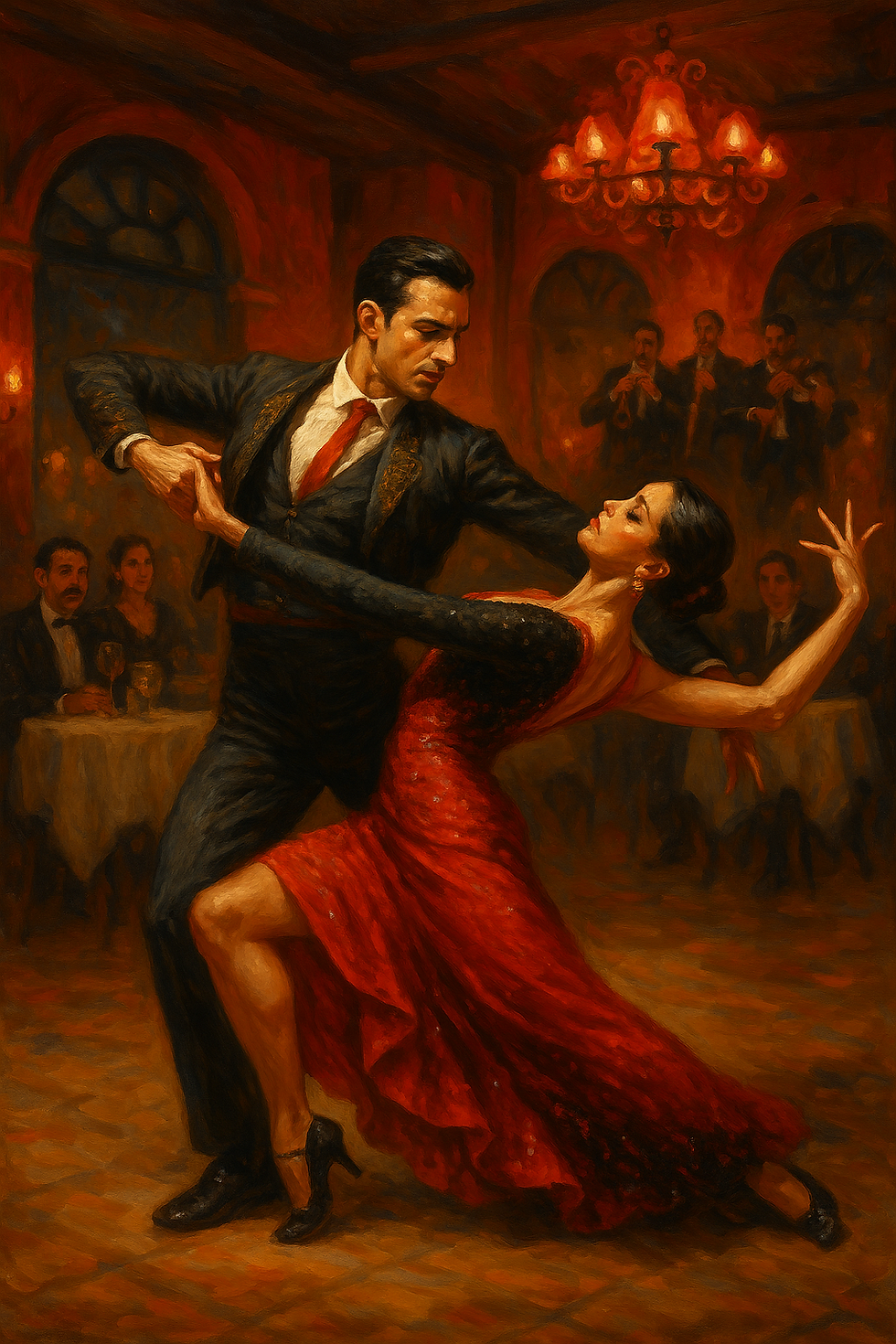
In the golden heart of Madrid, beneath the twilight-stained sky and the old whispering tiles of Calle de la Libertad, there stood a restaurant named El Silencio de la Rosa The Silence of the Rose. Ironically, it was never silent. Every night, from its arched windows burst rivers of trumpet, guitar, laughter, and the kind of clinking glass melody that only passion can compose. The walls, painted in deep flamenco red, seemed to pulse with the rhythm of Spain itself, and the chandeliers, dripping like melting candlelight, swayed in time with every breath of drama.
Tonight, as fate sharpened her quill and dipped it in ink, a night unlike any other had begun. And I was there not as a participant, but as the silent chronicler of divine choreography. In the realm of man, we call it coincidence. But in the language of the soul, it is nothing short of providence.
The waitstaff dressed like toreadors floated from table to table with practiced grace, delivering plates that looked more like edible paintings than meals: bacalao al pil-pil, jamón ibérico, and paella de mariscos crowned in saffron glory. The scent alone was a benediction.
And in the corner, beneath a wrought-iron balcony and a single spotlight, the band began to play.
A paso doble.
Not just any song. Not a filler. Not background music.
It was an invocation.
And heaven, amused and leaning on its elbow, watched.
At the center of the restaurant stood Alejandro. You couldn’t miss him. His presence was gravitational. With slick black hair, eyes like fresh-brewed espresso, and a jawline that could have sliced jamón, he looked like a man born from castanets and cigar smoke. Dressed in a charcoal matador-style jacket embroidered with golden vines, he stood motionless, waiting.
Across the room, seated with her cousin and pretending to care about her vino tinto, was Inés flame wrapped in skin. Her dress was crimson, slit high and glittering with jet-black beads like stardust spilled on fire. Her hair was pulled into a sleek moño, revealing a neck that made poets believe again in sonnets.
She saw him.
He had already seen her.
The air changed.
Not metaphorically. Literally. Glasses fogged.
He stepped forward.
“¿Bailas conmigo?” [Will you dance with me?] he asked, voice deep and deliberately slow.
She smirked, setting down her glass with exaggerated elegance. “Pensé que nunca lo preguntarías.” [I thought you’d never ask.]
Now let me tell you something about the paso doble. It isn’t just a dance. It’s a declaration. It’s not courtship it’s conquest. It’s not subtle it’s spectacle. And unlike other dances, this one was about him. The man leads, but not gently. He is not offering an invitation; he is drawing a sword.
He took her hand.
The floor was theirs. The world ours, temporarily ceased to exist.
The music thundered.
He began with a sharp chassé, slicing across the marble like lightning across a midnight sky. She responded with a sweep of her body, her dress flaring behind her like the cape of a fleeing goddess. Every step was a heartbeat, every turn a threat, every pose a dare.
He spun, his arms commanding the room’s attention as though he were the very bullfighter the music celebrated. She moved not behind him, but around him, like his shadow made of flame. She was the cape yes but not limp or passive. She was alive, unpredictable, and dangerous.
“¡Olé!” someone shouted from a corner table, and it was not sarcasm. It was reverence.
Alejandro executed a lunge a deliberate, sweeping motion that ended with his chest high and his left arm slicing the air. Inés matched it with a spiral, her heels clicking like the ticking of destiny’s clock.
“¡Madre mía!” whispered an older woman near the bar, fanning herself with a napkin. Her husband looked on, utterly defeated by biology.
The restaurant had vanished. We were no longer in Madrid. We were inside a bullring of emotion, beneath the eyes of saints and sinners, as the man and the woman told a story with no dialogue and no narrator only rhythm, fire, and fury.
The music surged into the trío, that second melodic act meant to quicken breath and blur reason. They mirrored it perfectly. He advanced, she retreated. He pressed, she circled. At times, it was unclear who was chasing whom, or whether it even mattered.
And then the pause.
A single beat of silence. Sacred. Suspenseful.
They stood, eyes locked. She had her back arched, arm lifted like a dagger. He was grounded, ready, unyielding. It looked like love.
It also looked like war.
Then came the final compás that last flourish where the man strikes the matador’s pose, arm lifted as if invoking thunder, and the woman collapses into a graceful sweep beside him like the last sigh of the sun over Andalusia.
Silence fell. Not out of respect. Out of shock.
A single spoon clattered to the floor. Somewhere in the back, a tourist gasped, “Jesus Christ,” which seemed both apt and underwhelming.
Then came the applause. Explosive. Relentless. The kind of applause that demanded the laws of physics be suspended for just a few more moments.
Alejandro bowed. Inés didn’t. She turned, collected her shawl from the chair, and walked away with the kind of poise that only a woman who wins while letting him think he did can muster.
Now, let me pause here not to end the story, but to say this:
That dance? That dance was life.
That paso doble was a sermon.
We often think life is a waltz, don’t we? Soft, expected, partnered. But in truth? It’s a paso doble. Bold. Demanding. The tempo never slows for our doubts, our fears, our insecurities. It requires us to step forward, even if our legs tremble.
And the divine?
The divine isn’t in the background, waiting for us to falter.
No, Dios es el matador. [God is the bullfighter.]
He leads with purpose, commands attention, and dares us to follow.
Sometimes, we are Alejandro confident, proud, captivating.
Other times, we are Inés graceful but guarded, dancing dangerously close to surrender and yet never letting go of our own rhythm.
But always, always, we are part of the choreography.
Life isn’t a solo.
We think we improvise, but really, the music has been written.
It’s just waiting for us to step into it with courage.
Paso doble.
Two steps.
One forward, one back.
Faith, then fear.
Hope, then hesitation.
Advance, retreat.
But the point, my dear reader, is that you keep dancing. You face the bull. You wear your scars like embroidery. You lift your arms and demand heaven notice.
And sometimes, just sometimes, the divine pauses the music not to stop the dance, but to watch you in awe.
So the next time the music swells, when life dares you to step out on the marble floor and be seen don’t ask if you're ready. You are. The dance was made for you.
“¿Bailas conmigo?”
Yes.
Always, yes.


Comments