
Don’t Let the Water In !
- Kateb-Nuri-Alim

- Dec 18, 2025
- 6 min read
Don’t Let the Water In
Porch Talk from New Orleans on Wisdom, Ego, and Who Deserves a Seat Close to You
Reflection written by Kateb Shunnar
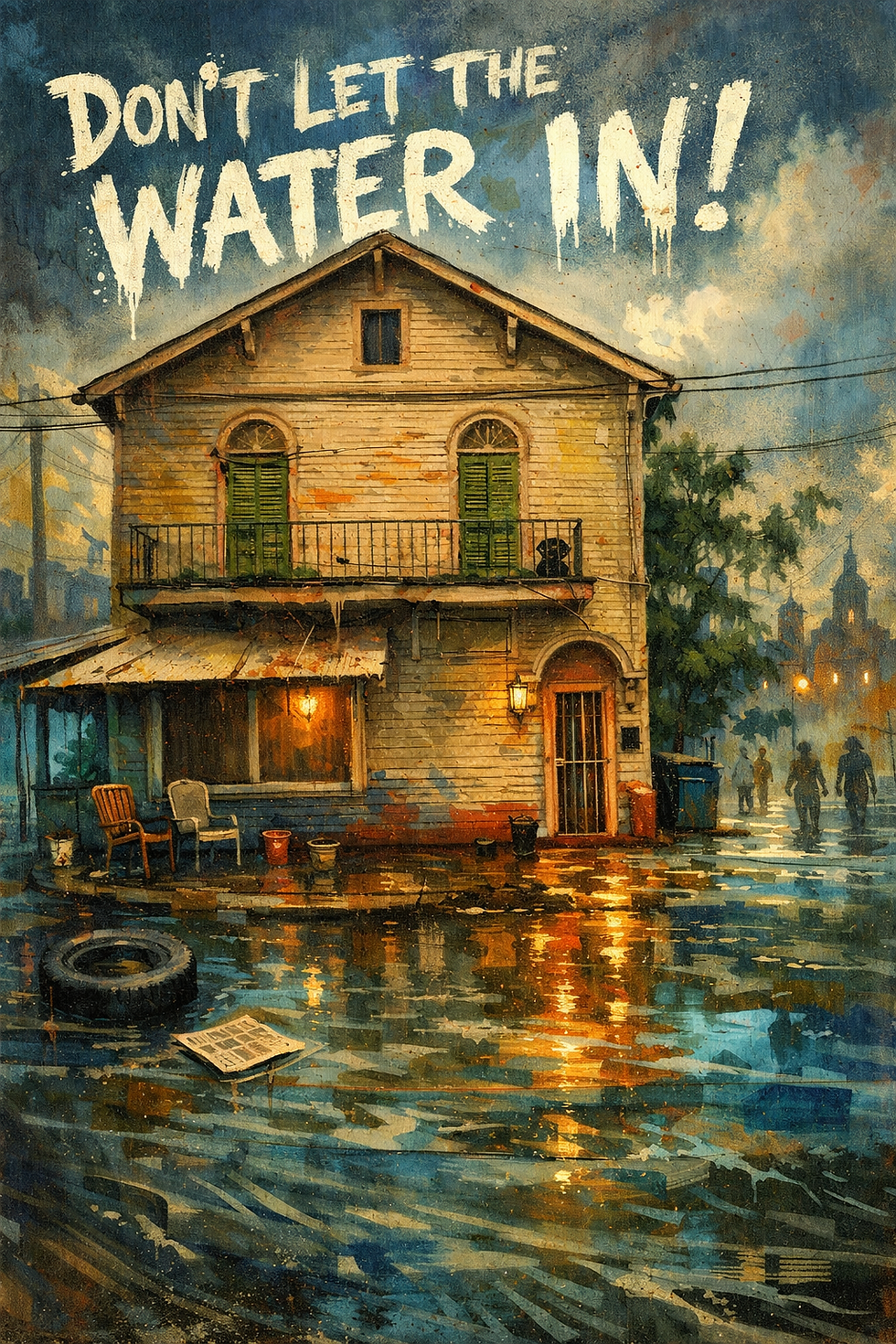
We used to live at 2800 Orleans Avenue, right on the corner of White Street, and if walls could talk, that porch would have a whole testimony. We sat out there damn near every day, watching cars roll down Orleans like everybody had somewhere urgent to be, engines revving, bass lines rattling windows, folks leaning on horns like that was gonna part traffic like the Red Sea. Meanwhile, we had nowhere to go except right where we were. We sold frozen cups red, blue, grape, sometimes half-melted if the sun got disrespectful. Quarter a cup. Fifty cents if business was moving or if we felt fancy that day. People would slow down, squint at us, negotiate like they were buying land instead of sugar water, then peel off like they stole something. And all the while, life was parading past us in real time arguments between couples who swore they were in love, kids dragging bikes too big for them, old heads walking slow like they had nowhere else to be but exactly where their feet landed.

That porch taught me patience before I knew patience had a name. It taught me how to watch without needing to comment on everything. It taught me that stillness can be productive and that movement doesn’t always mean progress. Folks were flying by, but we were learning. There’s a difference. Sitting there long enough, you start to notice patterns. Who waves back. Who pretends not to see you. Who always looks like they running from something invisible. That porch showed me early that being surrounded by people don’t mean you supported, and being alone don’t mean you abandoned.
Somewhere between those frozen cups and those passing cars, a truth settled into me and never left: ships don’t sink because of the water around them; they sink because of the water that sneaks inside. Anybody from New Orleans understands water on a personal level. We don’t romanticize it. We respect it. Fear it. Pray about it. Joke about it when the anxiety gets loud. Water is life and threat at the same time. Life works the same way. Pressure is inevitable. Disappointment shows up uninvited. Folks will talk, judge, project, advise loudly and incorrectly. But what takes you under isn’t what’s happening around you it’s what you let inside, what you allow to sit in your chest and marinate until it starts steering you.
That goes for people too. Everybody near you ain’t meant to be close. Some folks come with leaks. They drip insecurity, bitterness, envy, and bad advice like a faucet that won’t shut off. You spend too much time around that and suddenly you heavy, tired, irritable, doubting your own instincts, calling it “growth” when really it’s just emotional water weight. You gotta be mindful about who gets access to your inner rooms, because everybody don’t know how to sit quietly without breaking something.
My grandfather, Paw Paw Wallace, tried to explain that to me long before I had language for it. He was a quiet man, the kind who didn’t waste syllables. His voice stayed low, almost like wisdom didn’t feel the need to announce itself. He told me more than once, “Be humble, don’t let the Creator humble you,” and as a child I thought he meant don’t show off, don’t get too slick with adults, don’t let praise go to your head. But adulthood translated that message real clean. Humility is a choice. Being humbled is a process. And that process does not care how talented you are, how right you think you are, or how many people agree with you. Paw Paw believed creation has a way of lowering folks who insist on standing too tall in their own reflection. He didn’t say it mean. He said it matter-of-fact, like gravity.
I’m still dealing with that lesson in 2025. I still catch myself making excuses when a quick admission would do more good. I still wrestle with wanting to explain myself instead of just owning my part. But growth ain’t about perfection. Growth is about willingness. About choosing to fight yourself instead of fighting everybody else. I trust the birthing process of who I’m becoming, even when it’s uncomfortable, even when it’s slow. Especially when it’s slow.

Some of Paw Paw’s best lessons slipped out while we were doing ordinary things fishing, fixing that old Chevy van that always needed something, sitting at the baseball field with dust on our shoes and the smell of nachos floating through the air. He’d tell me to serve instead of shine, to help without counting eyes, to stop chasing recognition like it owed me money. He reminded me often that I couldn’t do everything alone, no matter how capable I thought I was. Depending on the Creator wasn’t weakness; it was alignment. “We plan, they plan,” he’d say, pausing long enough for the words to stretch out, “but the Creator the best of planners.” Life has backed him up more times than I can count.
One day he told me something that didn’t click until years later. “Never be the aggressor.” I asked why, thinking about playground scraps and teenage pride. He said, “The Creator ain’t never on the side of the aggressor.” I nodded and moved on. Years later, after my mother Marva passed, that sentence came back and hit me like a sudden stop in traffic sharp, unavoidable, rearranging. I realized then that loud doesn’t mean righteous, first doesn’t mean chosen, and forcing your way through life usually leaves you alone with your victory, wondering why it feels so empty.
Another time, after I got into a small squabble in my early years, Paw Paw told me something that changed how I carry my words. He said truth spoken with the intent to wound does more damage than a lie ever could. My mouth dropped open. My heart jumped. Something in me grew up right there. I became conscious not just of what I said, but why I said it. Words carry weight. They can soothe or scar. And sarcasm though I enjoy it deeply needs discipline if it’s gonna serve wisdom instead of ego.

As I grew, I noticed how life sends certain people into your orbit right when you’re vulnerable. Just as the Creator places people in your path for growth, negativity has its own timing. You tired, hurting, unsure, and here comes somebody loud and confident, telling you to take a left when your spirit already knows the right path is quieter and safer. They’ll hype your worst instincts, applaud your recklessness, convince you you don’t need guidance or accountability. And if you ain’t careful, you’ll mistake volume for wisdom and familiarity for loyalty. Discernment isn’t judgment it’s survival.
Over time, I learned that people show up in different ways and for different reasons. Some folks genuinely care about you. They check on you when you can’t offer nothing back. They stay when it’s uncomfortable. Then there are folks attached to what you represent your access, your influence, your energy. They’re present while it benefits them and fade when it doesn’t. And then there are folks who only stick around for a shared fight or a common enemy. Once the battle passes, so do they. Here’s the truth that stings a little: everybody in your circle is not your friend. Growing up together don’t make you friends. Working together don’t make you friends. Hanging out don’t make you friends. If that’s your definition of friendship, you might be handing out front-row seats to people who only paid for standing room.
We live in a microwave society. Everybody wants instant connection, instant loyalty, instant affection. Folks want deep bonds with shallow effort. But real care the kind that stays when it’s inconvenient that’s slow-cooked. It takes time. Heat. Patience. Humility. You can’t rush real relationships without burning them, and you can’t force closeness without poisoning it. That’s why genuine connection feels rare. Because it is. Rare doesn’t mean impossible. It means valuable.
Let me tell you a little New Orleans folklore. There once was a man folks called Big Boots Benny. Benny wore the loudest boots on Orleans Avenue. You could hear him coming a block away. He talked big, walked bigger, told everybody he was self-made and didn’t need nobody. Problem was, Benny boots had holes. Every time it rained and in New Orleans it always rains his boots filled with water. Instead of stopping to fix them, Benny just walked faster, splashing pride everywhere. One day, he slipped. Fell flat. Boots flooded. Ego soaked. Meanwhile, there was a quiet man named Old Lucien who walked barefoot when it rained. Folks laughed at him, but he never slipped. Moral of the story? Loud ain’t stable. Humility keeps you upright when the ground gets slick.
I’m still learning. Still unlearning. Still trusting the birthing process of who I’m becoming. I’m learning to keep water out the boat, to choose humility over ego, discernment over desperation, stillness over reaction. I’m learning that affection that lasts doesn’t announce itself and that wisdom usually whispers. And I’m learning that real love steady, patient, accountable love is rare, but it’s worth the wait.


Comments